
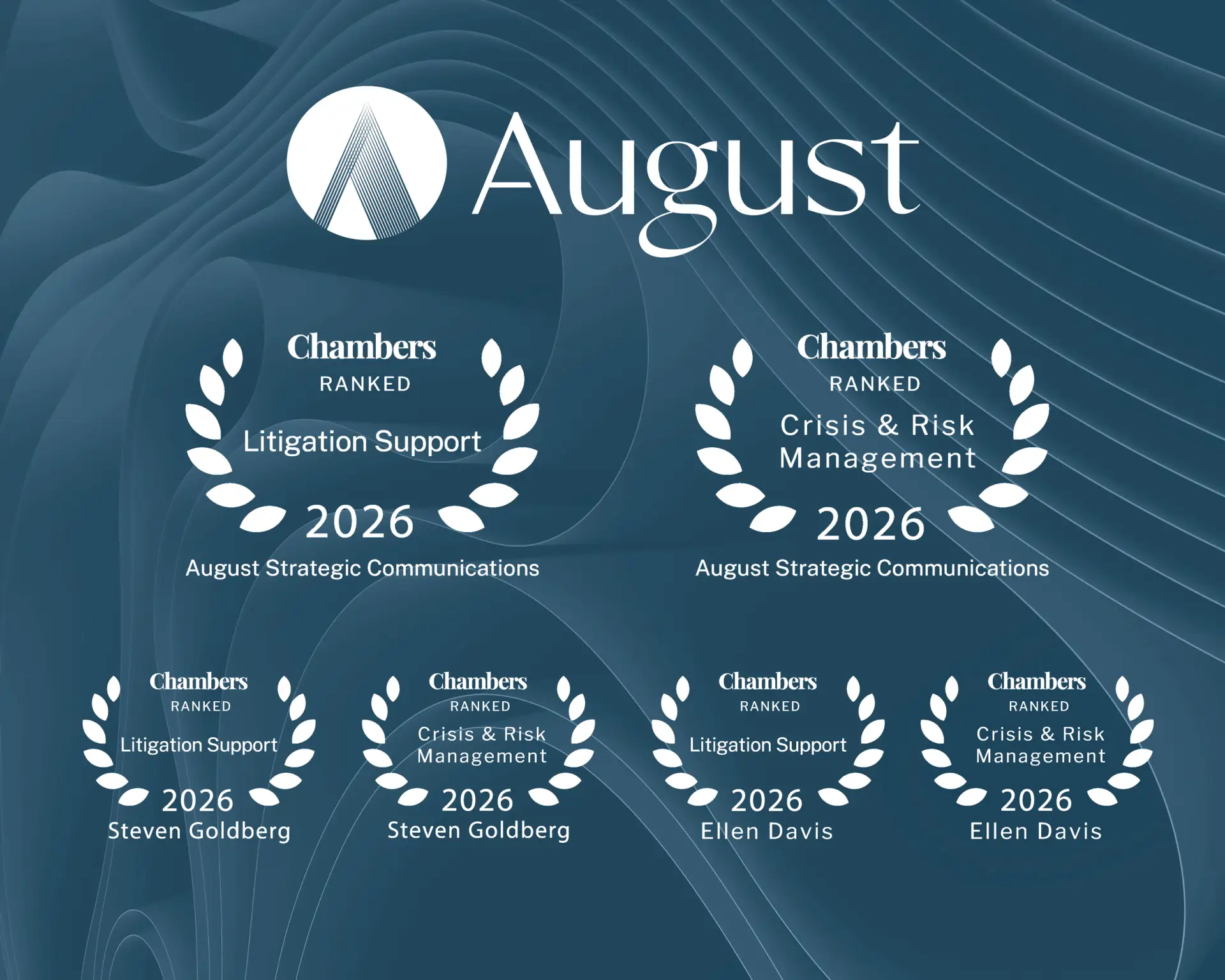
August is proud to once again be recognized as a Band 2 advisor in Chambers and Partners’ 2026 guides for crisis and litigation communications support. In addition to the firm’s rankings, Founding Partner and Chief Executive Officer Steven Goldberg and Partner Ellen Davis were again honored individually among the industry’s leading practitioners. Steven was named a Band 2 advisor in this year’s crisis guide and maintained his Band 2 ranking in the litigation guide. Ellen maintained her prior rankings in Bands 1 and 2 in the crisis and litigation guides, respectively. Those interviewed by Chambers and Partners highlighted August’s specialized expertise and demonstrated results while navigating complex crisis and litigation matters on behalf of our clients: As we approach August’s five-year anniversary later this year, we are honored to have been recognized by Chambers and Partners each year since the firm’s founding in 2021 alongside the industry’s leading firms and practitioners. This distinction underscores the dedication and talent of our team, and we are grateful to clients and referral sources for their continued confidence and partnership. August’s firm-wide and individual rankings can be viewed on the Chambers and Partners website: Crisis PR & Communications Litigation PR & Communications

Elizabeth Cholis Joins August as Senior Advisor
Experienced Crisis, Litigation, and Change Management Counselor Strengthens August’s Expertise in Guiding Clients Through High-Stakes Situations NEW YORK, March 30, 2026 – August, a specialized strategic communications advisory firm, announced today that Elizabeth Cholis has joined the firm as a Senior Advisor based in New York. Cholis brings more than 25 years of experience counseling senior executives and boards on complex situations, including high-profile litigation, government investigations, executive transitions, regulatory scrutiny, workplace matters, and business disruptions. At August, she will support client engagements and contribute to the firm’s work in crisis preparedness and response. “We’re thrilled to welcome Elizabeth to our team,” said Steven Goldberg, August’s Chief Executive Officer. “She has worked alongside leadership teams on some of the most complex and sensitive situations organizations face. Elizabeth brings strong judgment, a structured approach to problem-solving, and the ability to help clients think clearly and act decisively when it matters most.” “Elizabeth has deep experience helping organizations navigate issues where legal, reputational, and operational considerations intersect,” said Matt Harrison, Partner at August. “Her work in both preparedness and response will further strengthen our ability to support clients as they prepare for and navigate their most pressing challenges.” Cholis previously held senior roles at Brunswick Group, DGA Group, and FTI Consulting, and she has extensive experience advising clients on crisis preparedness, including risk audits, crisis response framework design, scenario planning, and tabletop and simulation exercises. She works with leadership teams to strengthen response capabilities and bring a disciplined approach to identifying and mitigating risk. “I’m excited to join August as a Senior Advisor and to work alongside a team that brings clarity and discipline to complex situations,” said Cholis. “I look forward to collaborating with the team and supporting clients as they prepare for and navigate challenging issues and periods of transition and transformation.” About August August is a specialized strategic communications advisory firm that believes that excellence in client service is achieved when individuals with specialized talent and subject matter expertise are empowered and given an environment to perform at their best. The firm is built on the foundations of authentic narrative development, deeply analytical engagement, and diligent execution. August advises clients on matters in several specific areas based on the unique expertise of its professionals, including: crisis management; litigation and investigations; corporate positioning and reputation management; financial transactions and shareholder activism; financial restructurings and Chapter 11 cases; individual representations; blockchain, digital assets, and fintech; healthcare; cybersecurity and data breaches; and diversity, bias, and discrimination. The firm serves clients across the U.S. and is headquartered in New York, with additional offices in Los Angeles and Dallas. Chambers and Partners recognized August as a top-ranked firm for Litigation PR & Communications and Crisis PR & Communications in its 2025 Guide. For more information, please visit www.AugustCo.com. Contact Matt HarrisonInquiries@AugustCo.com323.892.5562

Jeremy Jacobs Joins August as Senior Advisor
Experienced Advisor and Financial Communications Expert Deepens August’s Expertise in M&A, Shareholder Activism, and Investor Relations LOS ANGELES, August 13, 2025 – August, a specialized strategic communications advisory firm, announced today that Jeremy Jacobs has joined the firm as a Senior Advisor based in Washington, D.C. Jacobs brings more than 25 years of experience providing strategic counsel to C-suite executives and corporate directors in high-stakes M&A transactions, shareholder activism matters, and crisis situations. At August, Jacobs will lead and support client engagements with a focus on financial transactions, shareholder activism, and investor relations, and expand the firm’s network. “We’re thrilled to welcome Jeremy to August,” said Steven Goldberg, August’s Chief Executive Officer. “Jeremy is a highly experienced strategic communications advisor who has worked on many of the most complex and high-stakes corporate transactions and proxy contests of the last few decades. He will add tremendous value to our clients and support the continued growth of the firm’s financial communications practice.” “Jeremy is a skilled communicator with exceptional instincts in fast moving situations,” said Scott Deveau, Managing Director and Head of August’s Financial Transactions and Shareholder Activism Practice. “His experience as a trusted advisor inside the boardroom and at the deal table will further enhance our ability to provide valuable strategic counsel to organizations pursuing transformational deals and navigating critical shareholder matters.” Jacobs is the founder and principal of the strategic communications consultancy Key Message and previously worked at several prominent strategic and financial communications firms, including H/Advisors Abernathy, FleishmanHillard, and Joele Frank. He has helped hundreds of companies across industries and borders navigate both friendly and hostile M&A transactions, engage productively with and defend against shareholder activists, and enhance and protect their reputations. He has authored numerous articles on M&A, activism and investor relations under his own byline and on behalf of his clients, and overseen successful thought leadership programs for clients and agencies. Earlier in his career, Jacobs taught English literature and writing at the University of Pittsburgh and served as the assistant editor for a leading scholarly journal. Jacobs holds a bachelor’s degree in English from Duke University and a master’s degree in English from the University of Pittsburgh. “I feel privileged to join August as a Senior Advisor and help expand the firm’s work in transactional communications,” said Jeremy Jacobs. “I greatly admire August’s practical and bespoke approach and the firm’s fidelity to its areas of greatest expertise. We share the philosophy that every word matters when an organization’s reputation and value are on the line. I have a passion for complex challenges and look forward to collaborating with the August team as we bring our expertise and strategic counsel to bear on our clients’ high-stakes challenges.” About August August is a specialized strategic communications advisory firm that believes that excellence in client service is achieved when individuals with specialized talent and subject matter expertise are empowered and given an environment to perform at their best. The firm is built on the foundations of authentic narrative development, deeply analytical engagement, and diligent execution. August advises clients on matters in several specific areas based on the unique expertise of its professionals, including: crisis management; litigation and investigations; corporate positioning and reputation management; financial transactions and shareholder activism; financial restructurings and Chapter 11 cases; blockchain, digital assets, and fintech; healthcare; and diversity, bias, and discrimination. The firm serves clients across the U.S. and is headquartered in Los Angeles, with additional offices in New York and Dallas. Chambers and Partners recognized August as a top-ranked firm for Litigation PR & Communications and Crisis PR & Communications in its 2025 Guide. For more information, please visit www.AugustCo.com. Contact Matt HarrisonInquiries@AugustCo.com323.892.5562

From Division to Direction: Ethereum’s Leaders Rally Behind ETH’s Economic Story
Our team recently supported the Ethereum community’s development, announcement, and promotion of its report, The Bull Case For ETH: Digital Oil, Store of Value, and Global Reserve Asset for the Digital Economy. The report, which examines the likely role and importance of Ethereum’s ETH asset in the future global economy, was spearheaded by Etherealize (Ethereum’s recently formed, institutional-investor-focused marketing and education arm) and promoted by Ethereum’s co-founders Vitalik Buterin and Joe Lubin, the Ethereum Foundation, and Coinbase’s Ethereum Layer-2 network, Base. The shared effort in developing the report and collective support of these key leaders quietly signaled a notable heel turn for some of Ethereum’s biggest names. For years prior to the report, in-fighting among the Ethereum community was rampant – with community members split on whether the leaders of Ethereum should remain focused on perfecting the technology behind the platform or allocate more of their resources to increasing global institutional and investor interest in Ethereum and its ETH asset. This in-fighting reached a fever pitch over the past year, as ETH’s price growth lagged far behind that of Bitcoin, despite several major technological upgrades and scaling breakthroughs. Ethereum’s leaders’ support for the “Bull Case for ETH” report was noteworthy because it marked the first time they have joined together to promote ETH’s economic value, indicating that the in-fighting may be coming to an end. The decision to present a unified front and focus on education, coupled with the U.S.’s growing focus on implementing legal frameworks for responsible and sustainable blockchain innovation (as evidenced by the Senate’s passing of the GENIUS act last week), suggests that an Ethereum renaissance may be around the corner – with the potential for the platform to usurp Bitcoin’s and stablecoins’ current stranglehold on the mainstream crypto conversation. The Ethereum community’s newfound narrative alignment has also coincided with a substantial uptick in Ethereum-based projects looking for support in seeding a broader narrative about the platform’s potential role as a foundational layer of global finance 2.0 and its value to forward-looking financial institutions. We expect this trend to continue in the coming months and believe the projects that can effectively insert themselves into this conversation and demonstrate their role in accelerating the adoption of Ethereum stand to benefit greatly. We encourage anyone interested in digital assets to keep an eye on this narrative, as we expect it to become a focal point of the global crypto conversation alongside growing chatter around stablecoins.
August Recognized in Chambers and Partners’ 2025 Guides for Excellence in Litigation and Crisis Communications
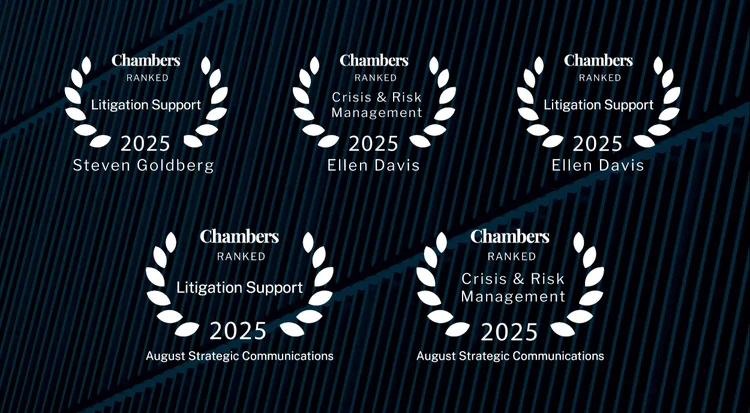
August is proud to have been recognized as a top advisor in Chambers and Partners’ 2025 guides for crisis and litigation communications support, advancing to Band 2 in the Crisis PR guide and maintaining our Band 2 ranking in the Litigation PR guide. In addition to the firm’s rankings, Chief Executive Officer and Founding Partner Steven Goldberg and Partner Ellen Davis were honored individually as top-tier advisors. Steven advanced to a Band 2 advisor in this year’s litigation guide, and Ellen maintained her prior rankings in Bands 1 and 2 in the crisis and litigation guides, respectively. Those interviewed by Chambers and Partners spoke to August’s specialized expertise and demonstrated results while navigating crisis and litigation matters on behalf of our clients: As a young firm approaching our fourth anniversary, we are honored to have been recognized by Chambers and Partners for four consecutive years alongside the industry’s leading firms and practitioners. This achievement is a testament to our team’s dedication and excellence across industries and practice areas. We thank our clients and referral sources for their continued support and partnership. August’s firm-wide and individual rankings can be viewed on the Chambers and Partners website: Crisis PR & Communications Litigation PR & Communications

“Stomp[ing] Loudly and Wield[ing] a Wet Noodle”: Analyzing the Rollout of President Trump’s Plan to Lower Pharmaceutical Drug Prices
On May 12, 2025, President Trump renewed his efforts to lower prescription drug prices for Americans via an Executive Order establishing a “most-favored nation” (MFN) pricing policy, which demands pharmaceutical companies charge the U.S. the same price they charge other developed nations – on average, about three times less. Industry experts have identified significant legal and practical challenges that may render this MFN policy unenforceable, but those issues aside, critical errors were made in communicating the Executive Order that have led to it being far less well-received than it otherwise could have been – particularly given the broad bipartisan support for addressing sky-high drug prices. These missteps offer valuable lessons for communicating announcements that extend beyond politics. Communications Pitfall #1: Setting Unrealistic Expectations On May 6, the President drew headlines by teasing that an announcement “as big as it gets” was forthcoming. Then, in a post on Truth Social on May 11, President Trump announced he would be signing “one of the most consequential Executive Orders in our Country’s history,” promising that “Prescription Drug and Pharmaceutical prices will be REDUCED, almost immediately, by 30% to 80%.” In reality, the impact of the Order remains speculative, with no concrete indication that it will lead to a decrease in pharmaceutical prices. The Administration would have benefitted from messaging that set more realistic and achievable targets for the MFN policy’s implementation so that expectations are already calibrated in the event of its failure, and some credibility could have been maintained. Takeaway: Realistic expectation-setting, transparency, and follow-through are crucial in high stakes announcements. While there’s often value in creating interest and excitement in positive news, positioning lofty goals or expected outcomes as certainties can cause irreparable long-term damage to credibility. This played out in the corporate world with WeWork Founder Adam Neumann, who set forth a grandiose vision for the company that never came to fruition, contributing to a series of events that led to a failed initial public offering and his ousting as CEO. Communications Pitfall #2: Vague Messaging The Executive Order was rife with vague language, immediately giving rise to confusion and uncertainty among policymakers, industry leaders, and the general public. Analysts and experts questioned how the President would enforce the Order, and commentary about its lack of clarity featured prominently in media coverage. A number of outlets highlighted a note from Raymond James healthcare policy analyst Chris Meekins, who argued the plan offers “words on a page, but not much substantive” and “reminds us of how in President Trump’s first term he was all bark, no bite on drug pricing.” Ameet Sarpatwari of Harvard Medical School told The New York Times that the Order “reads more like an aspirational statement than a serious attempt to initiate a policy change.” And as Matt Herper of STAT News noted, “In rolling out his plan to lower prescription drug prices, President Trump could have walked softly and carried a big stick. As pharmaceutical investors see it, he instead stomped loudly and wielded a wet noodle.” Takeaway: Clear and substantive messaging is fundamental to shaping media narratives and public perception about an announcement. In the corporate context, having the right messaging for a major announcement has a considerable impact on how well it is received, and by extension, how effective it is in pushing the company forward and helping it achieve its goals. One example is Apple’s 2020 decision to replace Intel processors in Mac computers with its own chips. A computer business designing its own processors is widely considered to be very risky, but the news was well received thanks to how Apple communicated it. Apple clearly articulated how it would empower developers to “build apps that run across the entire Apple ecosystem,” while also preempting concerns about potential platform disruption and compatibility by detailing the measures it had in place to mitigate these issues. The positive reaction enabled Apple to see its vision through, with the M1 Chip launching later that year and driving a major resurgence in sales and customer satisfaction for Apple’s Mac business. Communications Pitfall #3: Missed Media Opportunities Lastly, the President missed an opportunity to better control the narrative by leveraging his allies in the media. While he held a press event at the Order’s signing, he did not sit for any on-the-record interviews with prominent print or broadcast outlets. Given his statement that the Order was “one of the most consequential… in our Country’s history,” one would expect the administration to take a more proactive approach to media engagement. Takeaway: Strategically engaging with trusted media before an announcement is key to setting the tone for initial and subsequent coverage. For instance, Endeavor CEO Ari Emanuel and WWE Executive Chairman Vince McMahon pre-recorded an appearance on CNBC discussing the companies’ 2023 merger that aired right after the merger was announced, ensuring the rationale for the business combination was clearly articulated from the start in a manner that built investor enthusiasm for the deal. Pre-arranging interviews to publish shortly after announcement can also help strengthen long-term relationships with reporters and editors, which can be leveraged down the road to maximize the impact of good news. And in the event of any negative developments, reporters will typically be more receptive to the company’s perspective and frame the news with fair consideration for the company’s side of the story. Conclusion Many communications best practices are universal, regardless of whether you’re the CEO of a public company or the President of the United States. In order for announcements to be well received, it is important to set realistic expectations, craft clear and consistent messaging, and take full advantage of strategic media opportunities.

Scott Deveau Joins August as Managing Director and Head of Financial Transactions and Shareholder Activism Practice in New York
Experienced Advisor and Former Bloomberg Deals and Activism Reporter Deepens August’s Expertise in Shareholder Activism, M&A, and Other Capital Markets Events NEW YORK, January 23, 2025 – August, a specialized strategic communications advisory firm, announced today that Scott Deveau has joined the firm as a Managing Director and Head of the Financial Transactions and Shareholder Activism Practice. Based in New York, Deveau will lead client engagements with a focus on matters involving shareholder activism, mergers and acquisitions, and other capital markets events. “We are thrilled to welcome Scott to August,” said Steven Goldberg, August’s Chief Executive Officer. “His experience helping some of the world’s most prominent investors and companies manage communications throughout a wide range of complex financial matters will add tremendous value to our clients and support the continued growth of the firm.” Deveau has spent more than a decade on the front lines of some of the most high-profile activist investor campaigns and financial communications matters across the U.S. and Canada. Prior to joining August, he served as a partner at another prominent strategic communications firm, where he launched a financial communications offering in Canada and helped lead high-profile client engagements that included Browning West’s successful proxy campaign to replace the entire board at Gildan Activewear and Arkhouse’s attempt to acquire Macy’s and refresh its Board, which resulted in the appointment of two Arkhouse nominees to the Board. His clients have included some of the largest and most prominent activist investors in the world. For nearly 20 years, Deveau was a leading financial journalist, most recently for Bloomberg News in New York. Deveau previously reported at the National Post, the Globe and Mail in Toronto, and as a war correspondent in Afghanistan for Canwest News Service. Deveau holds a B.A. from Queen’s University. “In just three years, August has set itself apart as one of our industry’s premier firms,” said Deveau. “In getting to know the team, it has become evident that they are a uniquely talented group of individuals whose success has been driven by a deep-seated passion for the work that we do, an unflagging commitment to providing best-in-class client service, and a culture of empowerment. I’ve been an admirer of August’s since the firm launched, and I could not be more excited to contribute my experience and expertise and help drive the growth of this impressive organization.” About August August is a specialized strategic communications advisory firm that believes that excellence in client service is achieved when individuals with specialized talent and subject matter expertise are empowered and given an environment to perform at their best. The firm is built on the foundations of authentic narrative development, deeply analytical engagement, and diligent execution. August advises clients on matters in several specific areas based on the unique expertise of its professionals, including: crisis management; litigation and investigations; corporate positioning and reputation management; financial transactions and shareholder activism; financial restructurings and Chapter 11 cases; blockchain, digital assets, and fintech; healthcare; and diversity, bias, and discrimination. The firm serves clients across the U.S. and is headquartered in Los Angeles, with additional offices in New York, Dallas, and San Francisco. Chambers and Partners recognized August as a top-ranked firm for Litigation PR & Communications and Crisis PR & Communications in its 2024 Guide. For more information, please visit www.AugustCo.com. Contact Matt HarrisonInquiries@AugustCo.com323.892.5562

Nuggets of Wisdom: Comparing the Responses of Boar’s Head and McDonald’s to their Respective Food Safety Recalls
News broke on Tuesday that an E. Coli outbreak linked to McDonald’s’ popular Quarter Pounder hamburger led to the death of one person and sickened at least 48 across ten states, sending the company’s PR machine into overdrive. So far, McDonald’s has handled the situation about as well as any organization in its position could hope to. Given our critique earlier this week of Boar’s Head’s mishandling of its recent listeria outbreak, we wanted to explore why and how McDonald’s has been more successful in mitigating damage to its brand under nearly identical circumstances. Takeaways Choosing the right communications channel Boar’s Head’s initial communications consisted of a highly technical press release and a boiler plate media statement that Boar’s Head was “cooperating fully with government authorities and conducting [its] own investigation into this incident,” neither of which was effective in connecting with stakeholders or putting them at ease. In contrast, McDonald’s disclosed the news by cross-posting a brief but detailed internal employee note to its corporate blog that included a video address from McDonald’s USA President Joe Erlinger. This made for a much more accessible and compelling first communication that focused on conveying the most important details in a digestible, human manner. Where Boars’ Head’s press release felt overwhelming and overly corporate, reading like the disclosures segment of a prescription drug advertisement, McDonald’s communications were sharp, to the point, and used channels and formats that were more familiar and comfortable to their target audience. Anchoring response in corporate values Boar’s Head’s initial press release disclosing the recall was over 1000 words long, and yet none of those 1000 words indicated how the company felt about the recall, or how it fit within the context of the company’s values. Granted, this press release did follow a format required by the USDA, but the company could have supplemented it with additional communications that more clearly articulated their position on the incident. Instead, their data dump release left customers wondering whether the company’s health code violations were just par for the course for an organization that made no mention of prioritizing food safety or the well-being of its customers. McDonald’s, on the other hand, started with their values. The first two lines of their cross-posted internal message read: “Across the McDonald’s System, serving customers safely in every single restaurant, each and every day, is our top priority and something we’ll never compromise on. It is why we are taking swift and decisive action following an E. Coli outbreak in certain states.” McDonald’s made clear the outbreak was directly at odds with its corporate principles and that its rapid response was driven by a desire to uphold those principles, eliciting comments like the below on Joe Erlinger’s video address: Taking ownership In responding to the listeria outbreak, Boar’s Head has not attributed its statements or communications to a specific spokesperson. Even the customer letter that the company issued a month after the initiation of the recall was signed by the company, rather than the CEO or another corporate leader. McDonald’s attached two credible spokespeople to its crisis. North America Chief Supply Chain Officer Cesar Piña was listed as the author of the internal message, and USA President Joe Erlinger appeared in the video. By positioning two leaders front and center and having them take ownership of the incident, the company’s response came across as much more genuine than Boar’s Head. Humans connect better with one another than they do with brands, so assigning a leader to be the face of a company’s crisis response – someone who does not skirt responsibility or make excuses – can be an effective means of rebuilding credibility with consumers. Communicating empathy This was perhaps the only category in which McDonald’s joined Boar’s Head in falling short. As in Boar’s Head’s case, McDonald’s initial communications failed to express empathy for those who have so far been impacted by the outbreak, including the individual who died after contracting E. coli. As we speculated in our article regarding Boar’s Head, this may stem from concerns that an expression of empathy could be interpreted as an admission of guilt and carry legal liability. However, we believe there are ways to communicate empathetically without admitting fault, and it felt strange for McDonald’s to emphasize its values so aggressively without ever mentioning the impacted individuals. This sentiment was even raised by one commenter on Joe Erlinger’s video: A little can go a long way – even a simple, “We are aware of the reports of individuals falling ill from E. Coli and want to share our heartfelt sympathies to those suffering from this terrible illness” would help offset any perception that McDonald’s response was heartless or lacking in empathy. Communicating empathy At this stage, the score card is clearly in McDonald’s favor, as it bested Boar’s Head in all but one of the above categories. However, it can take months for a crisis of this magnitude to play out, with many more opportunities for missteps. It remains to be seen whether McDonald’s can maintain the largely positive momentum from its initial response, or if the situation will worsen and make long-term reputational harm all but inevitable. To avoid further damage, it is critical that McDonald’s clearly communicates its final findings regarding the source of the outbreak, as well as the steps it is taking to ensure that another, similar outbreak does not occur in the future.

Ham-Fisted Crisis Management: A Disaster at Boar’s Head
For months, Boar’s Head has been navigating a major product recall and related plant shutdown that have led to a USDA investigation, potential criminal charges, and class action lawsuits. The company’s communications have been lacking at many key inflection points during this tumultuous period, and the company’s leadership and ownership are now under significant scrutiny. Below, we share some key communications learnings from Boar’s Head’s existential crisis. Communicate with empathy… At the outset of the recall, Boar’s Head and USDA issued a technical press release, and the company separately issued a boilerplate media statement saying that it was “cooperating fully with government authorities and conducting [its] own investigation into this incident.” The company’s first social media post regarding the recall was a generic message on its corporate Instagram account, stating, “[a]t Boar’s Head, the health and safety of our customers is our top priority.” It is likely that legal concerns and a lack of conclusive information resulted in the company’s barebones statements in the early days of the recall. Even so, Boar’s Head could have included more empathetic messaging in its statements without jeopardizing its legal strategy – expressing more concern and sympathy for those impacted without assigning blame or taking ownership. The company also could have more effectively demonstrated that it was taking the situation seriously by disseminating its statements more proactively and frequently across social media and other channels. It’s important to leverage all relevant channels to reach your key stakeholders, even if you are still gathering information and planning next steps. …and do so quickly Beyond its minimal press release and anodyne day one media statement, Boar’s Head remained silent for four days after the start of the recall, and in doing so missed a crucial window of opportunity to communicate with key external stakeholders and shape the narrative. It was not until a month after the recall’s initiation that the company released a more substantive communication via a product recall page on its website. While the letter hit many of the right messages – e.g., apologizing effectively for the tragic loss of life and impact to all customers, as well as outlining concrete actions the company is taking to improve food safety – it was too little, too late. Organizations must balance legal and reputational considerations as they develop and execute communications strategies – the best of which enable the timely dissemination of empathetic and informed messaging that does not endanger the legal strategy. Choose your spokesperson wisely… or, at least, have a spokesperson Recent reporting has revealed that two families have been fighting over ownership of Boar’s Head for years and that the company’s leadership is unclear even to some of its C-level executives. Headlines such as “The Secretive Dynasty That Controls the Boar’s Head Brand” (New York Times) and “The Boar’s Head deli company is so secretive that a top executive didn’t know the name of the CEO” (Fortune) have left the public wondering who actually pulls the strings at Boar’s Head. So, when an otherwise well-crafted letter to customers regarding the crisis was signed by the company and not its CEO, it only added fuel to the speculation about the company’s leadership and left the letter feeling more hollow and corporate than sincere and driven by empathy. Humans connect better with one another than they do with brands. Thus, electing a credible spokesperson – typically a CEO or other member of corporate leadership who takes ownership and responsibility – can be an effective mitigating factor against the negative reputational impacts of a crisis. In the absence of such a figure, it can be difficult for a company to earn back public trust. Skeletons in your closet? Find them! Near constant media coverage of Boar’s Head’s recall has put the company under a microscope. Now, its internal strife and lack of clear leadership are being exposed for all to see. When one crisis occurs, others may follow, making a bad situation even worse. Companies experiencing a crisis will almost certainly be scrutinized more closely than before, reinforcing the importance of proactive risk management and crisis preparedness. Where to go from here Boar’s Head has its work cut out if it wants to earn back trust and repair its reputation. Below are a few steps the company could consider taking to help right the ship: These steps alone are unlikely to completely resolve their current reputational challenges – but following up these initial efforts with a programmatic, multi-channel campaign that clearly and compellingly communicates how Boar’s Head has gone above and beyond to rectify the underlying issues that led to the crisis may give the company a fighting chance.
August Recognized in Chambers and Partners’ 2024 Guides for Excellence in Litigation and Crisis Communications
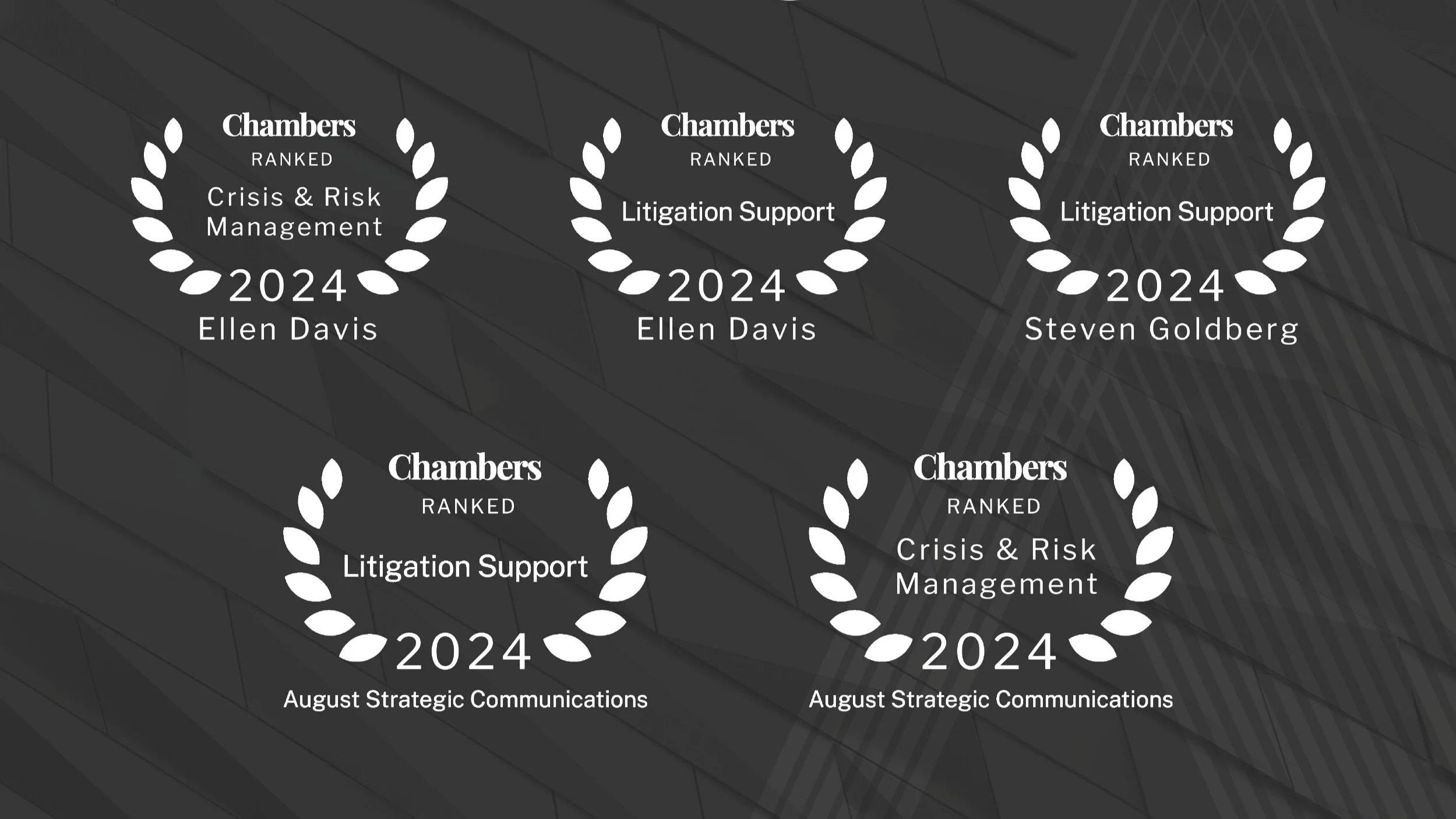
August is proud to have been ranked as a top advisor in Chambers and Partners’ 2024 guides for litigation and crisis communications support. In addition to the firm’s ranking, Chief Executive Officer Steven Goldberg and Senior Managing Director Ellen Davis were recognized individually as top-tier advisors. The firm advanced to Band 2 in the Litigation PR guide and Band 3 in the Crisis PR guide. Steven was recognized in the litigation guide for the first time as a Band 3 advisor, and Ellen maintained her prior rankings in Bands 1 and 2 in the crisis and litigation guides, respectively. Those interviewed by Chambers and Partners emphasized August’s strong track record navigating complex crisis and litigation matters on behalf of our clients: “August has tremendous reach within the PR and news media space: when they talk, people listen. They are skilled at taking charge of strategic narratives from the beginning.” “The team at August are super smart, extremely responsive, and well prepared, with the right mixture of intellectual candlepower and common sense. They are wonderful team players and a class act.” It is an honor to have been recognized again for our specialized expertise alongside the industry’s leading firms and practitioners. To have achieved these rankings as a young firm approaching our third anniversary is a testament to our outstanding team, and we thank our clients and referral sources for their continued partnership and support. August’s firm-wide and individual rankings can be viewed on the Chambers and Partners website: